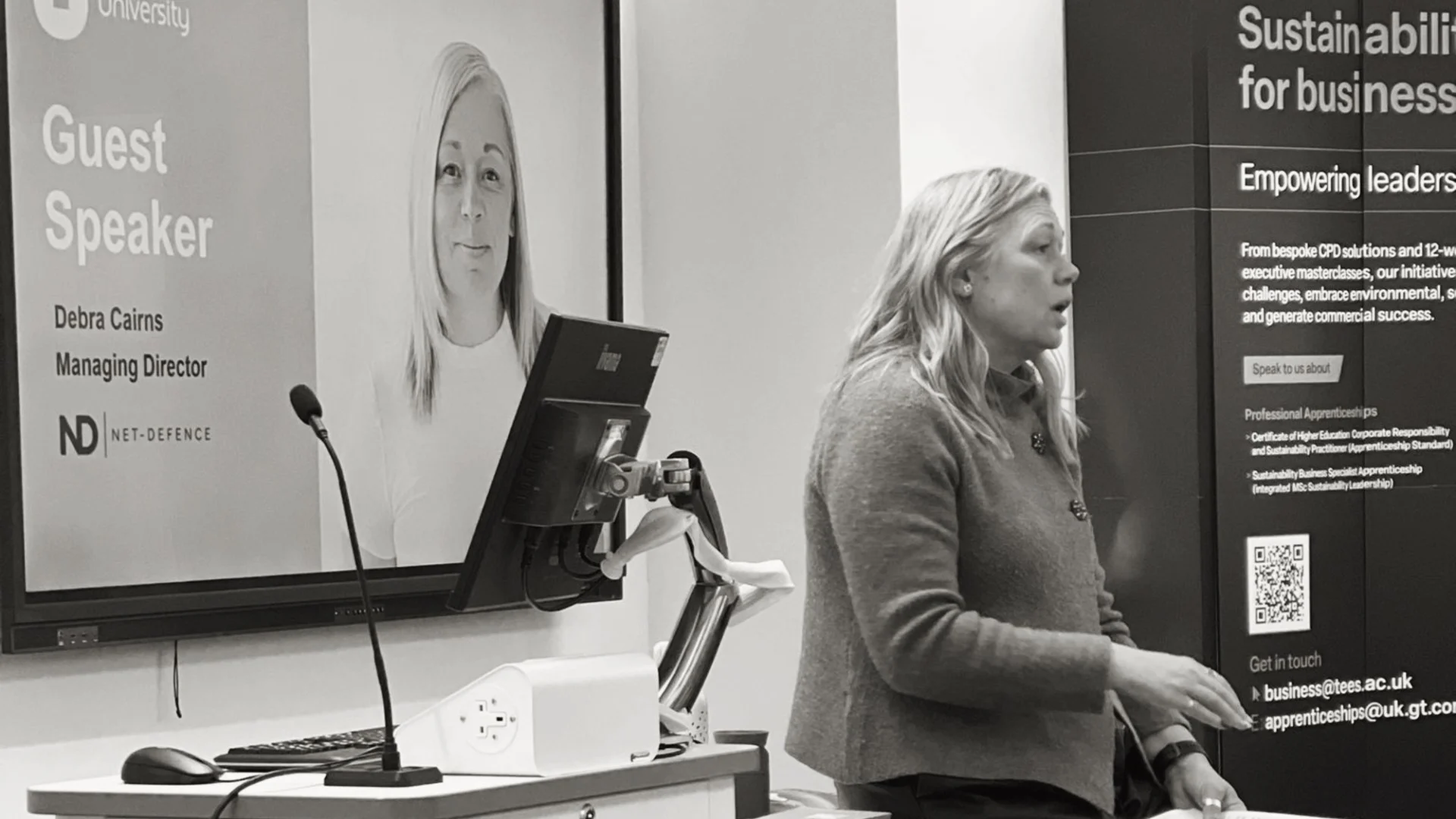
Leadership is a huge topic that is impossible to cover in a single session. So, when I was invited to speak at Teesside University, I chose to focus on the power of Emotional Intelligence (EQ).
After years of leading teams, navigating pressure and scaling organisations at Net‑Defence, I’ve learned that it’s not our intention that shapes our leadership; it’s how people experience us. This is where Emotional Intelligence (EQ) shifts from a soft skill into a genuine superpower.
Why self-awareness is the foundation of effective leadership
People experience us through our behaviour, our emotional signals and our default style, whether we’re conscious of them or not.
If you aren’t aware of your natural preferences, strengths and blind spots, and how they affect others, you’re setting yourself up to fail.
Failure in leadership shows up in many forms:
- Employee retention issues
- Recruitment challenges
- HR conflicts
- Increased sickness or burnout
- Reduced loyalty and engagement
Almost everyone has experienced a ‘bad boss’ at some point. In many cases, the problem isn’t competence, it’s a lack of self-awareness about how their behaviour lands with others.
Understanding your natural style is the first step toward mastering your EQ superpower.
The Myers-Briggs Type Indicator (MBTI) framework
One of the most widely used frameworks for understanding leadership behaviour is the Myers–Briggs Type Indicator (MBTI), developed by Isabel Briggs Myers and Katharine Cook Briggs.
MBTI helps people understand their natural preferences in how they gain energy, process information, make decisions and approach structure or change.
These preferences combine to form 16 personality types, each with its own strengths, tendencies and potential blind spots.
The framework looks at four key preference pairs:
- Extraversion (E) or Introversion (I): Where people draw their energy from
- Intuition (N) or Sensing (S): How people take in and interpret information
- Thinking (T) or Feeling (F): How people make decisions
- Judging (J) or Perceiving (P): How people approach structure and planning
For decades I’ve known my personality profile is ENTJ, a combination often associated with strategic thinking and drive.
Being the rarest female MBTI type
It turns out that being an ENTJ puts me in a very small room. Globally, this type represents only around 1.8% of the population, making it one of the three rarest MBTI types worldwide. When you look at the data for women, that rarity becomes even more pronounced. Estimates place ENTJ women at just 0.9-1.5% of the population, the rarest female MBTI type in many datasets.
In a leadership context, these strengths have allowed me to drive clarity, direction, and momentum. But like every leader, I’ve had to learn that the unmanaged side of these strengths can quickly become blind spots.
The very traits that allow an ENTJ to excel can, if left unchecked, create friction. Without self-awareness, we can be:
- Impatient with slower-paced thinkers
- Overly direct when operating under pressure
- Focused on logic at the expense of emotional nuance
- Inclined to take on too much in the pursuit of a goal
- Drawn to control when outcomes matter most
Self-awareness isn’t about fixing these traits or changing who you are at your core. It’s about managing them. The goal is to ensure you remain authentic, and your strengths land as intended.
Colour energies & the Insights Discovery framework
Many leadership programmes also translate these preferences into colour-based models, such as the Insights Discovery framework, which can make personality dynamics easier to understand in teams.
The four colour energies are typically described as:
- Fiery Red: Direct, decisive, action-oriented and results-driven
- Sunshine Yellow: Expressive, enthusiastic, sociable and idea-focused
- Earth Green: Supportive, patient, collaborative and relationship-focused
- Cool Blue: Analytical, precise, structured and detail-oriented
Most people are a blend of all four, but we tend to have stronger natural preferences in certain areas. When I recently completed a light version of the Insights Discovery model, the results aligned closely with my ENTJ profile: my style sits strongly in Fiery Red and Cool Blue energy.
Flexing without faking
Understanding your dominant colours helps you recognise how your style may energise some people while unintentionally challenging others. This brings up a common leadership question: How do I adapt to others without losing myself?
Staying authentic while flexing your style isn’t about acting or pretending. It’s about being aware of the impact you have and choosing behaviours that support the people around you.
As a Red-dominant leader, I’m naturally fast-paced and action-driven. For me, Green energy (checking in, asking how someone feels, or creating a sense of calm) isn’t something I lack; it’s something I can easily overlook when I’m focused on outcomes.
This is where the EQ superpower becomes visible. When I dial up my Green energy, it’s not inauthentic. It’s intentional. It’s me saying:
“I do care, and I’m making sure you feel that, not just the pace and direction I bring.”
The key is not to overdo it or try to become a different colour entirely. It’s about adding just enough Green to balance my Red, so people feel supported rather than pushed. That’s not losing authenticity, that’s leading with self-awareness.
EQ: the differentiator that makes leaders truly effective
Leadership isn’t just about being good at the job. It’s about being good with people. That’s where emotional intelligence (EQ) becomes transformational.
Psychologist Daniel Goleman introduced a widely used framework built around five core domains:
- Self-awareness: Understanding your drivers, triggers and patterns
- Self-regulation: Managing emotional impulses and reactions
- Motivation: Acting from internal values and standards
- Empathy: Recognising and understanding others’ emotional states
- Social skill: Building relationships, trust and influence
Self-awareness forms the foundation. Without it, the other four are much harder to develop.
And this is where personality frameworks move from interesting to useful. Knowing I lead with strong Fiery Red and Cool Blue energy gave me language for my natural pace, intensity and standards. EQ helped me understand the impact of that energy on others.
My own team today is predominantly Earth Green and Cool Blue energy – thoughtful, collaborative, measured and relationship-focused – with a healthy dose of Sunshine Yellow creativity.
My Red energy brings pace and direction, but it only becomes valuable when it’s intentional rather than overwhelming.
Over the years I’ve learned to make small but important adjustments:
Dial my Fiery Red energy down by around 10-15%
Consciously lean into Earth Green behaviours – asking, listening and checking in
Add more Cool Blue detail when working with analytical thinkers
Bring Sunshine Yellow creativity into discussions early when shaping ideas
Modern leadership requires flexibility and adaptability
We no longer operate in a world where a single leadership style works.
Three realities now make high EQ non-negotiable for effective leadership:

The power of adaptability
EQ allows you to practice situational leadership. It’s the ability to read a room and shift gears, moving from directive to supportive, or from strategic to operational, without losing your core identity. It’s about leading with intention rather than just habit.
The architecture of safety
High-performance teams run on psychological safety. In high-pressure moments, your tone and reactions either open the door for innovation and honest challenge or quietly signal that it’s safer for your team to stay silent.
Emotional steadiness during change
When circumstances feel uncertain, people naturally look to leadership for signals about how to respond.
EQ provides the emotional anchor and clarity needed to create stability, helping a team remain calm and focused even when the wider environment is shifting.
A practical EQ tool: stop, see, shift
One of the simplest and most effective tools I use, both personally and when coaching leaders, is the STOP → SEE → SHIFT model.
It’s memorable, practical and easy to apply in real time.
- STOP: Pause and notice your instinctive emotional reaction.
- SEE: Observe what’s happening for the other person. Pay attention their tone, concerns, context and energy.
- SHIFT: Consciously choose the behaviour or communication style most likely to create the outcome you want.
For leaders who are naturally decisive and action-oriented, this short pause can dramatically improve how conversations land.
Final thought: EQ is the most underrated leadership skill
Emotional intelligence is often the least trained, least measured and yet most critical capability in leadership.
Early in a career, technical expertise tends to drive success. But as leaders progress, EQ quietly overtakes technical skill as the real determinant of influence, culture and performance.
The leaders who will thrive in the coming years are those who understand themselves deeply, manage their impact intentionally and adapt their style to bring out the best in others.
Self-awareness isn’t about being softer. It’s about being more effective. And it may just be the modern leader’s greatest superpower.
Take a moment to reflect on your own leadership style, identify your strengths and blind spots, and consider one small change you can make to lead with greater impact.